Maria Montessori
Maria Montessori was an Italian physician, educator, and trailblazer who became one of the first women in Italy to earn a medical degree. Her work with children began in hospitals and psychiatric clinics, where she noticed that young patients learned best through sensory experience and purposeful activity. In 1907, she opened her first Casa dei Bambini (“Children’s House”) in a low-income neighborhood of Rome, where she applied her observations to create child-centered classrooms filled with materials designed for independence, concentration, and self-discovery. The remarkable success of these children attracted worldwide attention and laid the foundation for what is now known as the Montessori method.
Read below to learn how Montessori education differs from traditional teaching approaches.
Montessori vs. Traditional
Mixed- Age Classrooms / 3 Year Cycle
Children learn in multi-age classrooms (e.g. 3-6, 6-9), following a three-year cycle of exploration, experimentation, and mastery/leadership. Completing the full cycle allows the child to experience the full impact of Montessori—building confidence, deep understanding, and leadership skills.
Following the Child
Teachers act as guides, observing each child's readiness and interests to introduce lessons at the right moment allowing children to more fully absorb the curriculum.
The Prepared Environment
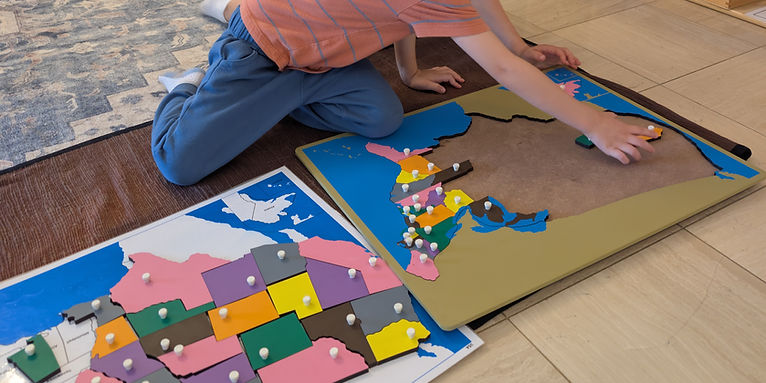
Classrooms are intentionally designed with hands-on materials that isolate skills and require active engagement. Everything has a place, which supports order, concentration, and independence.
Grace & Courtesy Lessons
Children are explicitly taught social skills-how to greet others, resolve conflicts, move respectfully, and care for the community.
Practical Life Activities
Children practice real-life skills like setting their table, cleaning up after themselves, dressing, and care for the environment. These build coordination, responsibility, and confidence.
Same- Age Classrooms
Students are grouped strictly by age and are expected to move through material at the same pace.
Teacher-Led Instruction
Teachers direct the learning through whole-group lessons and a fixed schedule.
Traditional Classroom Materials
Materials may or may not have a purpose or require engagement depending on the school. Materials that entertain are commonplace which require nothing from the child.
General Behavior Expectations
Social behavior is an afterthought that is addressed as needed and typically only when there is an issue rather than built into the curriculum.
Limited Student Responsibility
Teachers typically do most things for the children—zipping coats, cleaning spills, organizing materials, and managing routines. They are rarely expected or taught to handle these tasks themselves which reduces opportunities to develop life skills and independent habits.
Montessori Outcomes
Executive Function
64
%
A single large-scale study confirmed, on average, Montessori students outperform 64% of their non-Montessori peers in executive function—critical skills like focus, self-control, and managing distractions.
Academic &
Social-Emotional Skills
The same single large-scale study confirmed superior outcomes in both domains: Montessori children consistently score 59% better than their peers in core academic subjects like reading and math, and also demonstrate stronger social-emotional skills, including empathy and effective problem-solving.
Accelerated
Academic Progress
+
1
yr.
A systematic review by the Campbell Collaboration, which analyzed 32 high-quality studies from 8 countries concluded that Montessori students were, on average, a full school year ahead by sixth grade, with the most significant academic gains noted in language, math, and general academic ability.
59
%